
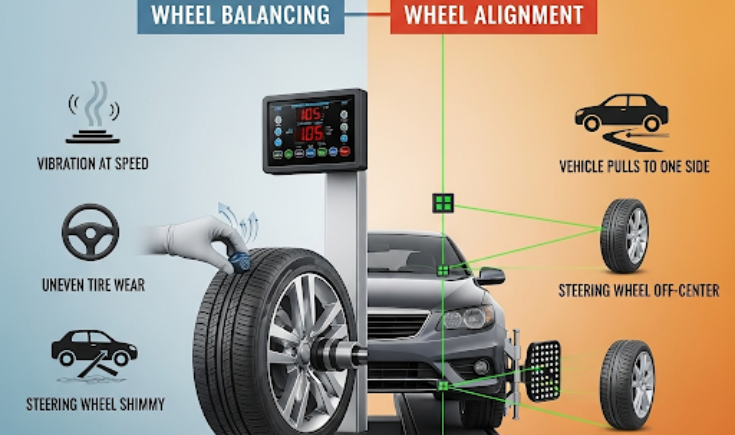
When it comes to car maintenance, wheel balancing and wheel alignment are often confused but they’re not the same. Both are essential for a smooth, safe, and fuel-efficient drive, yet they address different issues with your tyres and wheels. Knowing the difference can help you maintain your vehicle better and avoid costly repairs.
What is Wheel Alignment?
Wheel alignment is the process of adjusting your vehicle’s suspension so the wheels are set to the correct angles as specified by the manufacturer. Proper alignment ensures your tyres are parallel to each other and perpendicular to the road surface.
Benefits of Wheel Alignment:
- Improves fuel efficiency
- Enhances handling and safety
- Prevents uneven tyre wear
- Extends tyre lifespan
Signs You Need Wheel Alignment:
- Your car pulls to one side
- Uneven or rapid tyre wear
- Off-centre steering wheel while driving straight
What is Wheel Balancing?
Wheel balancing ensures that the weight of the wheel and tyre is evenly distributed around the axle. This is done by adding small weights to the wheel to correct any imbalances.
Benefits of Wheel Balancing:
- Reduces vibrations in the steering wheel
- Improves ride comfort
- Prevents premature tyre and suspension wear
- Protects steering components
Signs You Need Wheel Balancing:
- Vibrations in the steering wheel or seat
- Uneven tyre tread wear
- Recent tyre replacement or repair
Key Differences Between Wheel Alignment & Wheel Balancing
| Aspect | Wheel Alignment | Wheel Balancing |
|---|---|---|
| Purpose | Adjusts wheel angles for proper contact with the road | Ensures even weight distribution around the wheel |
| Impact | Affects tyre wear, fuel efficiency, and handling | Affects ride comfort and prevents vibrations |
| When Needed | After hitting potholes, curbs, or every 10,000 km | After installing new tyres, every 5,000–10,000 km |
| Tools Used | Alignment machines and sensors | Balancing machines and wheel weights |
Why You Need Both
While wheel alignment ensures your tyres meet the road correctly, wheel balancing ensures a smooth rotation without vibrations. Skipping either can lead to premature tyre wear, increased fuel consumption, and compromised driving safety.
Final Thoughts
Wheel alignment and wheel balancing work hand in hand to keep your car performing at its best. Regular checks not only extend your tyre’s life but also improve safety and comfort on the road. If you’re experiencing vibrations, pulling, or uneven tyre wear, it’s time to get both services checked.
Frequently Asked Questions (FAQs)
Q1. I just got new tyres. Do I need an alignment, balancing, or both?
A1: Definitely both! Wheel balancing is a must for every new tyre to ensure it rotates smoothly. A wheel alignment is highly recommended at the same time to make sure your new tyres start their life pointed in the right direction, preventing uneven wear from day one.
Q2. Which is more important, alignment or balancing?
A2: That's like asking if water or food is more important! They are equally vital but solve different problems. Balancing gives you a smooth, vibration-free ride. Alignment ensures your car drives straight and protects your tyres. You need both for a safe and comfortable driving experience.
Q3. Can hitting one bad pothole really mess up my alignment?
A3: Yes, absolutely! A single hard impact with a nasty pothole or curb can easily knock your suspension out of its precise alignment settings. If you've had a noticeable jolt, it's wise to get your alignment checked, even if you don't feel a major pull immediately.
Q4. How often should I get them checked if my car feels fine?
A4: Preventative checks are key to a long tyre life! As a rule of thumb, check your balancing every 5,000-7,000 km and your alignment every 10,000 km or at least once a year. This helps catch small issues before they lead to big problems.
